The Growth AI Playbook
A practical playbook for growth leaders ready to move from ad-hoc AI usage to a compounding, AI-powered operating system.
AI is the most potent accelerant for growth teams, but only if it’s used beyond ad-hoc transactional queries. This playbook shows you how to do that. Its core is a set of foundational principles that hold true regardless of which AI model or tool drops next.
The method combines agentic coding with deterministic automation. This approach can solve many marketing problems immediately, while limiting much of the risk that comes with using an AI agent in privacy-sensitive, high-spend environments.
This is the high-level framework expanded on in depth below:
- 1. Build a changelog for AI to connect cause and effect
- 2. Map your opportunities
- 3. Designate an AI lead
- 4. Document knowledge in plain language SOPs
- 5. Translate your SOPs into model directives
- 6. Use AI to write scripts
- 7. Automate execution
- 8. Iterate and maintain
- 9. Measure impact
Some examples of what you can build with this framework:
Build a Changelog
A well-maintained changelog is infrastructure for AI. Language models don’t retain memory between sessions. A changelog gives them the data to connect cause and effect.
Track all meaningful changes using timestamps. When you start a campaign, adjust budgets, launch new creative, or ship a new landing page etc. Start manually, then automate entries using ad platform APIs. Too much data degrades AI output quality and increases cost, so you’ll need a clear key structure to filter data for AI ingestion.
Map Your Opportunities
You shouldn’t build solutions for problems that don’t exist. Understanding your opportunities and their size will help you gain internal support and build a prioritized roadmap.
Look for two types of problems:
- Manual bottlenecks: Repetitive work that can be automated
- Decision gaps: Decisions made with insufficient data or made too slowly
Map those to AI solutions:
- Generation: Keywords, ad copy, landing pages, email variants, creative briefs
- Analysis: Deep channel insights, review mining, cross-source creative trends
- Process optimization: Briefing, compliance review, creative naming
Start broad across your stack, then select a single channel to analyze for your first tool.
Designate a Growth AI Lead
Using AI tools beyond ad hoc queries typically requires internal collaboration and approvals. A dedicated lead makes that collaboration easier.
Assign a team member to own this initiative full-time for an initial sprint (2–4 weeks). Form a cross-functional team with your AI lead, an engineer or data scientist, and someone who understands compliance and security.
Document Your SOPs
Your SOPs become the foundation for every AI tool you build. They are the knowledge layer your agent will reference, capturing hard-earned insights and serving as the basis for the directives the model will use.
Capture three inputs:
- Internal best practices: What already works? The unwritten rules your best operators follow.
- Data-derived patterns: Re-review historical tests and performance data.
- Industry best practices (optional): Proximity to a channel creates blind spots. Use an LLM to synthesize public information into a best practices summary.
This is where your changelog becomes powerful. Feed it, along with performance data, to an LLM to identify trends and opportunities. Then adjust your SOPs and directives accordingly.
Build Directives
Directives tell the coding agent how to use your SOP. How should AI interpret inputs, apply rules, and output decisions. Directives ensure you get the results you’re looking for.
Draft input, execution, and output directives for your channel analysis tool:
- Input directives: Specify what data the model receives, formatting rules, and how to interpret metrics.
- Execution directives: Use an LLM to ingest your SOPs and generate execution directives in markdown. Be explicit about the decision framework.
- Output directives: Define what actionable output looks like. What decision should this inform? Should it output a spreadsheet, report, Slack message, or API payload?
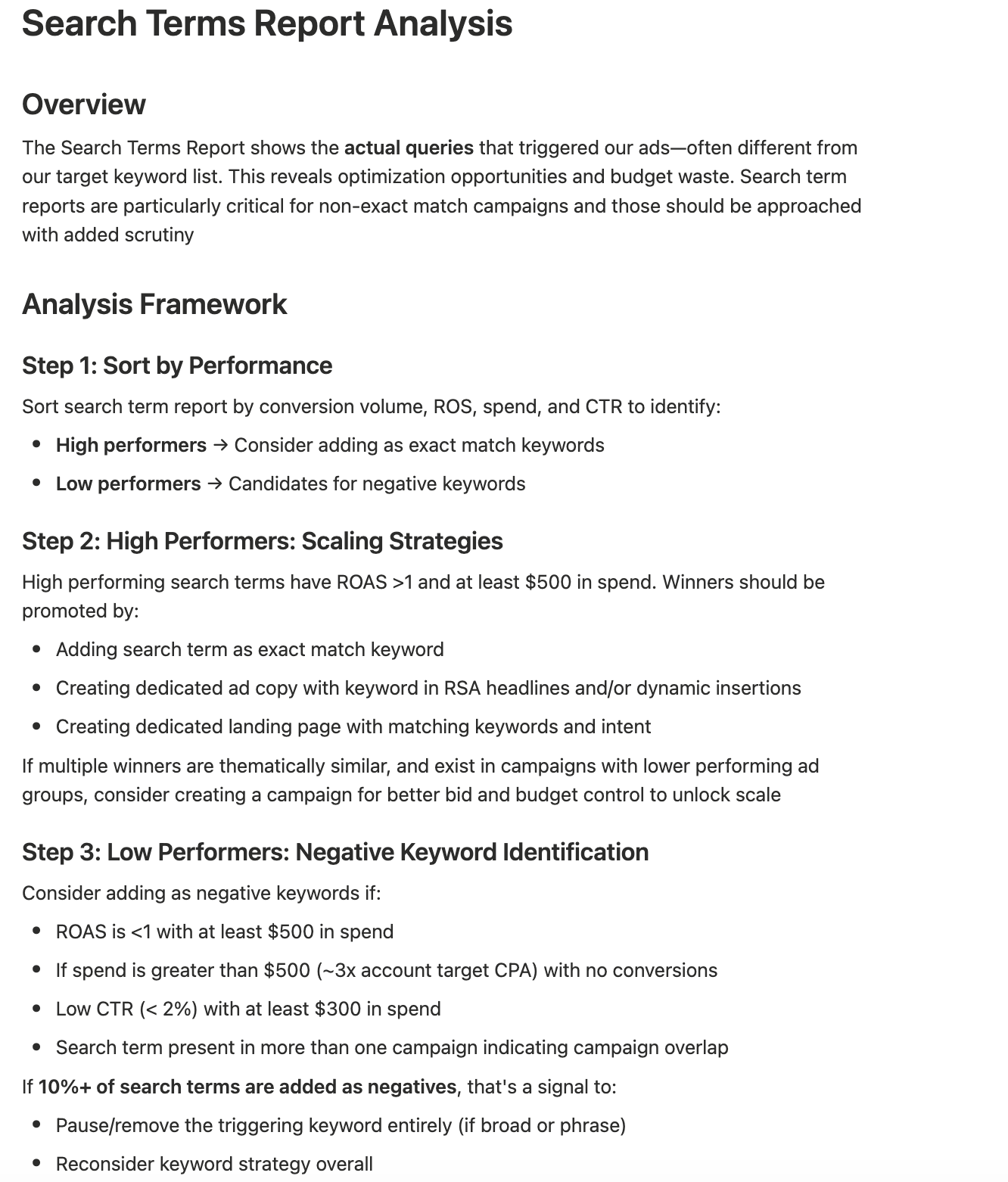
The SOP
Hard-won rules encoded in plain language.
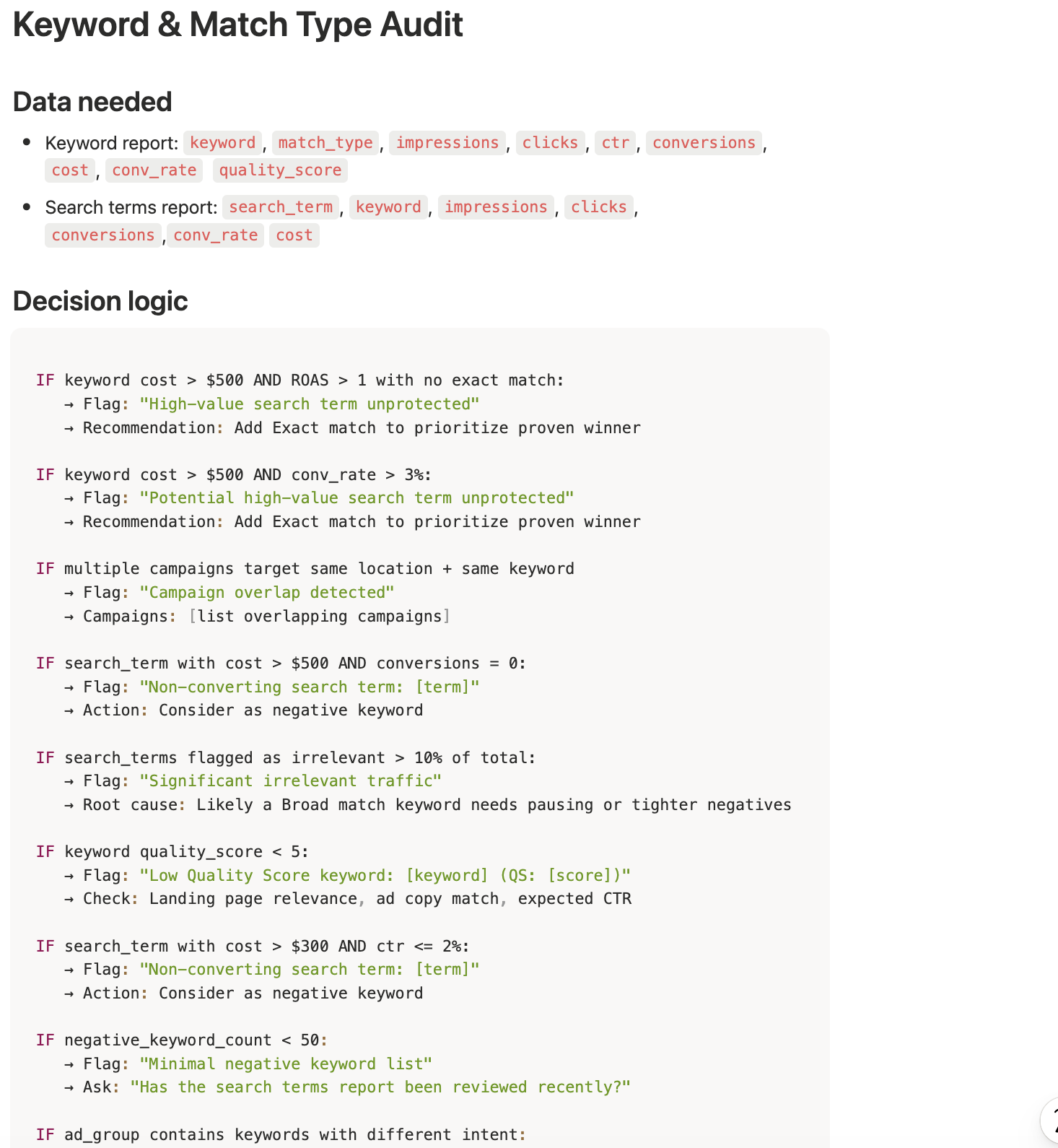
The Directives
Directives are your SOPs turned into a precise framework for the model to evaluate data it receives.
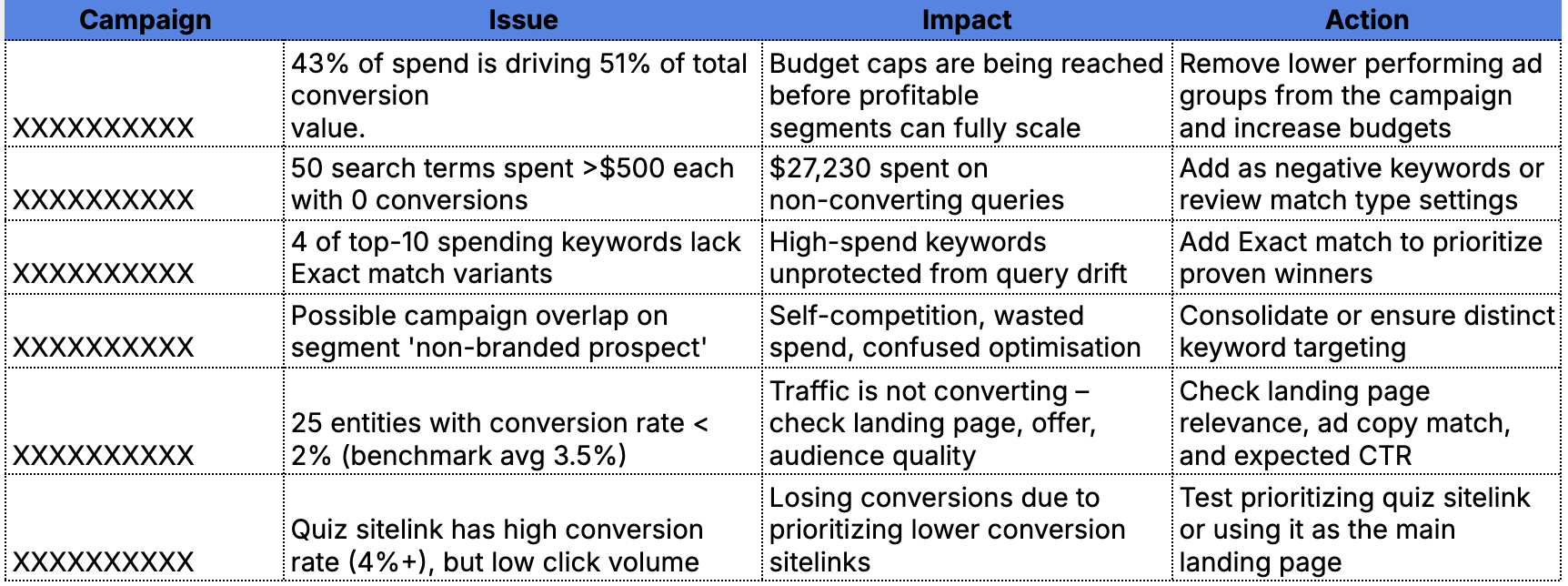
The Audit
What the tool produces: a prioritized table of issues, each with a clear impact and specific next action.
Use Agentic Coding
The underlying scripts are the core building blocks. You need to build, test, and iterate on those before introducing additional complexity and risk with automation.
You’re going to build your channel analysis tool and then have the agent run it with raw data before automating it. Open your coding agent (Claude Code, Cursor, Windsurf, etc.) in the folder where your directives and raw data live. Paste this prompt:
Sample Prompt
I want to build a Python script that analyzes [channel] performance data.
I’ve included:
- directives.md — instructions for how to interpret inputs, run analysis, and format outputs
- data.csv — raw performance export from [platform]
Build a script that reads the CSV, applies the logic in the directives, and outputs a [Markdown report / CSV / Slack message].
Do not add scheduling or automation. The script should run locally with a single command.
Before writing code, summarize your understanding of what the script should do and ask me any clarifying questions.
Monitor the model’s progress and thinking. If results didn’t match expectations, tell the agent why and ask for solutions. The final line of the prompt surfaces misunderstandings before they become code you have to debug.
Orchestrate a Deterministic Workflow
Individual tools are useful. Connected tools can be transformative. Orchestration moves you from “a script that does X” to “actionable recommendations in Slack every morning.”
The basic process for automating your channel analysis tool: Query API for fresh data → Run Python scripts → Deliver report.
We’ve already built the Python scripts. Scheduling and delivery can be orchestrated with different tools: additional Python scripts with triggers, off-the-shelf automation tools like N8N, or an AI agent.
Iterate & Maintain Your Systems
Tools need to be updated as your knowledge evolves, external platforms change, and your scope grows.
Overall: Version everything. Don’t delete older SOPs or directives.
Updating your SOPs: Use your coding agent to update directives vs. changing code directly with a prompt such as:
Sample Prompt
Add a new analysis step after Step 3 based on this SOP [insert]. Do not change existing logic unless required. Summarize what you are adding before making changes.
Changing code with new directives:
Sample Prompt
My directives have changed. Review the current scripts and identify what logic needs to change. Summarize before making edits.
Measure Impact
Deployment isn’t the finish line. Internal AI projects die quietly because their impact was unclear, not because the tools broke.
Evaluate your project on: time savings, performance impact, and decision quality. One way is to run a test where you log, but don’t execute AI recommendations. Then compare what your team did without AI, to what they could have done with it.
Parting Notes
Marketing and growth will look fundamentally different a year from now. Teams, processes, and responsibilities will shift. Change is uncomfortable, but the outcome is higher leverage.
Growth teams will spend less time moving tickets and trafficking media, and more time applying creativity, judgment, and systems thinking.
The hardest part is starting. This playbook gives you a practical framework to do exactly that.